Fashion and stage costume have been intrinsically linked since the earliest days of the industry. Couturier Paul Poiret viewed fashion, theater, and parties as one unified art form, often using live performances to test forward-thinking silhouettes on Parisian audiences (The Metropolitan Museum of Art). Jeanne Lanvin served as the go-to couturier for celebrated Parisian actresses and sopranos like Yvonne Printemps, for who she created stage wardrobes for operettas and plays. (Les Archives de la Mode) Even Coco Chanel designed avant-garde costumes for Serge Diaghilev's Ballets Russes in 1924. In short, designers have long understood the need for theatrics when presenting their creations and realized that dressing bold, trendsetting women is one of the ways to carry their message to the wider public.
This decades-old relationship of the fashion runway and theatrical performance feeding one another is precisely what makes the Denver Art Museum’s presentation of the V&A’s landmark DIVA exhibition so interesting. In my conversation with curator Jill d’Alessandro and interpretive specialist Holly Harmon, we explored how that blurry line between high fashion and stagewear, as well as the archetype of the diva, continues to shape visual culture today.
The Runway as Theatre
Runway shows have never been mere product demonstrations; from the beginning, couturiers have choreographed their catwalk presentations as theatrical productions. When collections were originally shown a century ago, looks were shown “salon style”—an intimate gathering of clients and some press inside the couture house with models walking amongst the guests. By building intimacy and a strong emotional connection between the client and the designer, personal relationships developed and there was a sense of proximity to talent.
Today, that connection between the designer and the client is mediated by a network of go-betweens: fashion editors, celebrity stylists, influencers and digital media, and store buyers. It creates a completely different dynamic, allowing the “stage” to expand beyond the runway or concert hall to the red carpet and social media, where those go-betweens broadcast a brand's narrative to millions.
This plays right into the fact that modern fashion shows are a critical builder of brand equity. These shows cost houses hundreds of thousands of dollars with their professional lighting, soundscapes, choreography, and sometimes even set designs. It’s world-building on an immense scale. So when Chanel presents a haute couture collection in a mythical world of mushrooms, it’s not just about an environment to show the new season’s lineup, but the house constructing high theatre to evoke emotion and present their point of view before a single garment is ever sold.
The Red Carpet as Stage
With the introduction of television, cable TV, and social media, the "stage" for performers has become quite a bit larger than concert venues and in-person events. Over the course of the 20th century, the red carpet has become one of the most important spectacles for both performers and designers.
Today, The Met Gala red carpet is arguably the highest-stakes theatrical performance in modern pop culture. When an artist steps out in a couture creation—like Rihanna in Guo Pei’s embroidered yellow silk cape and dramatic train for the museum’s China: Through the Looking Glass exhibition in 2015—the red carpet isn’t just a photo op, but functions as a stage where fashion creates an unforgettable cultural moment. It is a broadcast engine where stylists and performers collaborate to turn 10-second clips into global brand equity.
And that moment is magnified through today’s social media platforms, which thrive on high visual drama, short-form content, and iconic stills. Platforms like Instagram and TikTok treat fashion as a sequence of performance beats, where a 10-second reel gets amplified to millions worldwide in seconds, reinforcing the idea that wearing clothing is an act of public theatre.
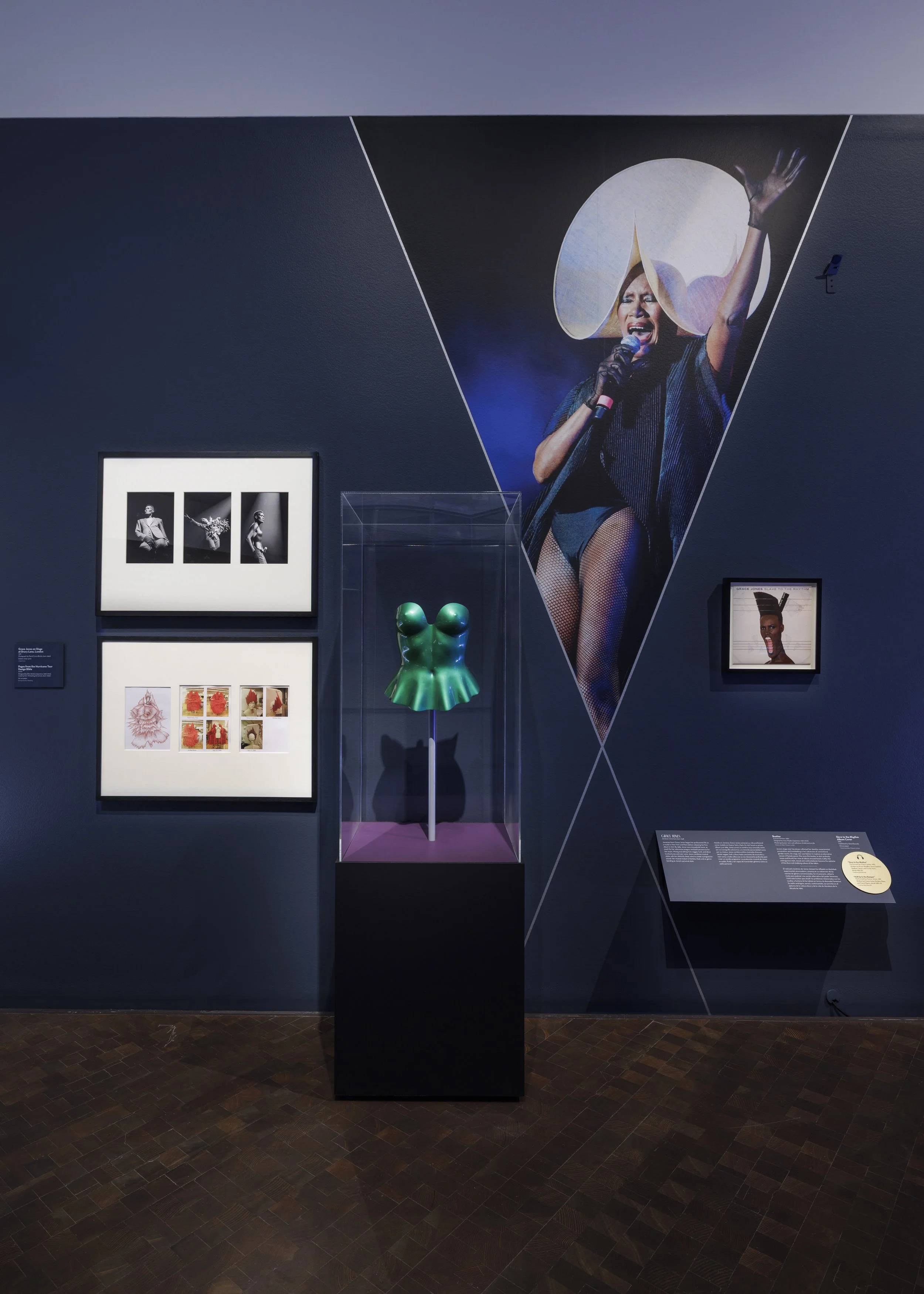
Issey Miyake molded bustier and Grace Jones, DIVA exhibition, Denver Art Museum. Image courtesy of the Denver Art Museum.
Runway Couture as Costume
The boundary between haute couture and stagewear completely dissolves when pieces designed for the catwalk transition directly into live performance. Consider Issey Miyake’s molded acrylic bustier, which moved from a sculptural runway piece into iconic stage armor for Grace Jones when she was just beginning her singing career. Similarly, when Pierpaolo Piccioli presented a tangerine-orange silk faille gown for Valentino Haute Couture Fall 2018, it was worn by Beyoncé during her On the Run II tour, but with an alteration to the deep plunging neckline to a higher, stage-ready fit. The gown was then re-imagined for Lady Gaga at the 2019 Golden Globes in periwinkle blue (a subtle homage to the gown Judy Garland wore in the 1954 version of A Star Is Born). In each case, a garment originally built for a 15-minute runway presentation was transformed into a performance garment or costume.
Obviously, adapting haute couture for the stage is more than a styling exercise; it demands a combination of craft and engineering. While runway garments are constructed for close-up scrutiny and delicate movement, stagewear must be engineered to endure arena lighting, high-tension choreography, and physical exertion without losing its silhouette. When an artist brings a couture piece onto the stage, they bridge the gap between delicate fashion artistry and durable performance engineering.
Beyond the technical craft lies a deeper cultural statement: reclaiming the archetype of the "diva" as the ultimate assertion of creative autonomy. Historically used to dismiss demanding women, the word diva describes an artist who requires absolute control over her narrative. Stage attire ceases to be a passive costume handed down by corporate gatekeepers; it becomes an active visual manifesto. By selecting uncompromising runway couture for the stage, these performers command how they are seen, using fashion as a communication vehicle to telegraph their identity, power, and self-sovereignty.
The Final Act
Whether captured in a social media reel, broadcast across an arena tour, or displayed inches away behind museum glass, fashion as theatre reminds us that garment design is ultimately storytelling.
When visitors walk through the gallery floor at the Denver Art Museum, they are not merely observing historical garments; they are standing in the presence of visual declarations that shifted culture. By taking runway couture onto the stage and into public spaces, these visionary artists proved that choosing what to wear is never a passive decision. Showing up dressed in a specific way tells people who you are at that specific moment in time—it is roll-playing, but it is also a statement of personal identity.
Lady Gaga at the 2019 Golden Globes Awards in Valentino Haute Couture, DIVA exhibition, Denver Art Museum. Image courtesy of the Denver Art Museum.