The New Pragmatism
After years of reading show reviews, it’s always interesting to me to see editors and journalists label a collection as “too commercial.” Calling this out as something of note implies that a runway show can be either commercial or creative but not both.
The reason I find it odd is because though creativity is an essential part of fashion, the point of being a designer or creative director is not to produce an art installation, but ultimately to a sell product. At a time when retailers are over-inventoried and the wholesale business model is under pressure, it is the brands that produce real world wardrobe options for their core clientele that will survive. Is that commercial? Perhaps. But if a designer embraces their unique point of view while successfully meeting their clients’ needs, then I would call that a success.
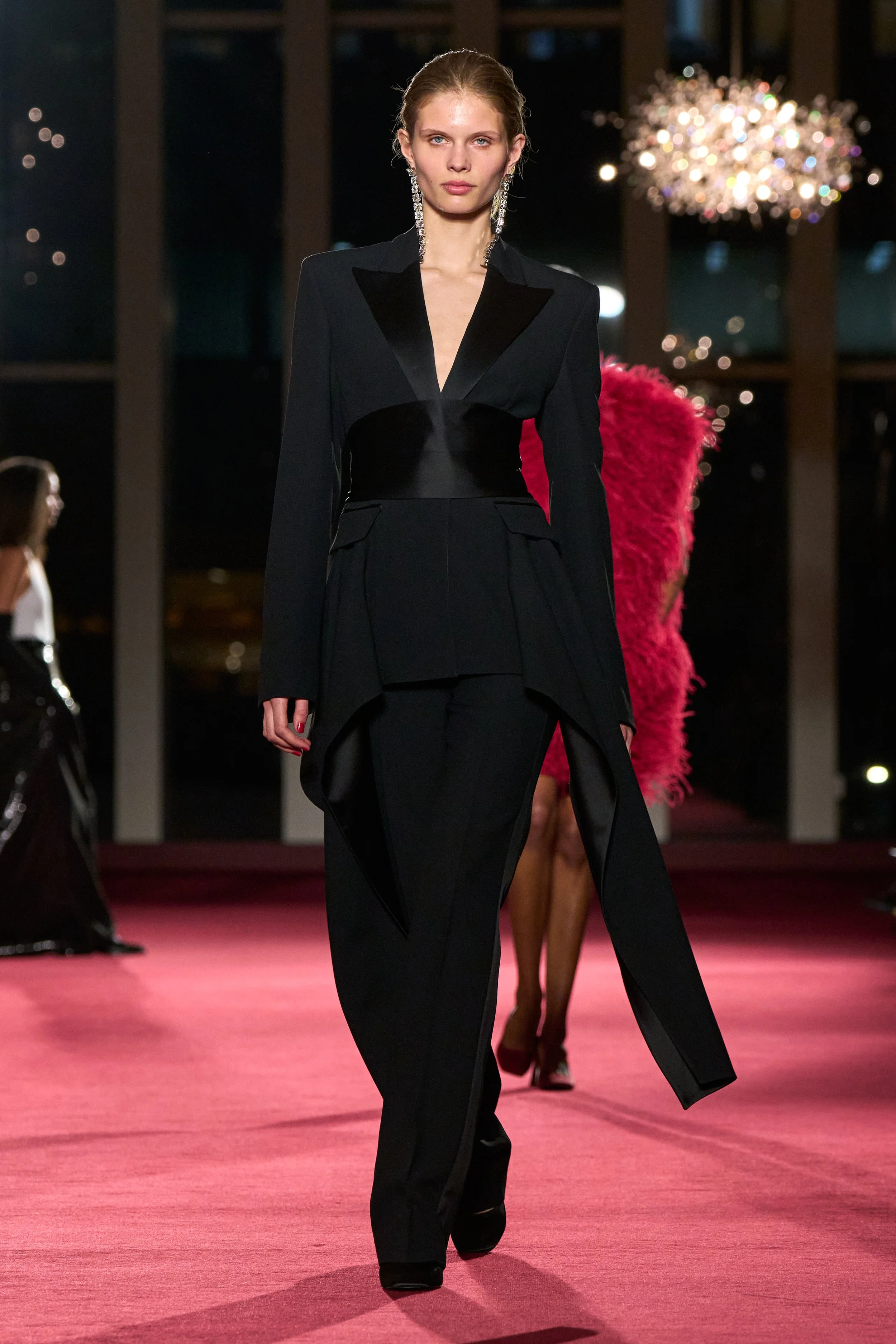
Michael Kors Fall 2026, Look 49. Photo courtesy of Michael Kors.
It’s why I thought some of the strongest shows at NYFW were ones that mined brand DNA while remaining entirely wearable. At Altuzarra, Michael Kors, Ralph Lauren, and Proenza Schouler, the collections embraced a nonchalant glamour and elegance that kept clients’ lifestyles top of mind. Equally important were independent labels like Henry Zankov, Collina Strada and Colleen Allen, who proved that a fashion-forward edge doesn’t have to sacrifice wearability.
However, while critics were busy debating “commercialism,” the most pressing issue for NYFW was one raised by designer Zane Li, the founder of Lii. Li, who showed a terrific collection that melded a casual athletic vibe with color blocking and sharp tailoring, noted that he struggles to sell his line in NYC. With international buyers increasingly bypassing NYFW, the fact that emerging talents can’t sell their lines on this side of the Atlantic is the discussion the industry should be having.
Across the pond, London Fashion Week suffers from the exact opposite problem: It is an indie brand haven where the “business potential” is often hard to find. While core names like Erdem, Richard Quinn, Simone Rocha, Tova, Edeline Lee, Chopova Lowena, and Pauline Dujancourt are a consistent draw, it remains to be seen how newer, niche labels will evolve into brands that can sell a client a full wardrobe rather than just a single “editorial” item.
In Milan, we saw Italian houses from Missoni to Fendi and even Prada look to functional pieces that play well with a woman’s existing closet. By the time the fashion set arrived in Paris, it was clear the most sophisticated shows were also the most wearable: the refined modernism of Issey Miyake, Uma Wang, Alaia, and CFCL, the elevated textures at Hermes, The Row, Dries Van Noten, and Akris, and the updated 1920’s silhouettes at Lanvin and Chanel. For the woman whose social calendar is filled with evening events, Saint Laurent, Valentino and Givenchy provided plenty of statement moments still rooted in reality.
Creativity is not at odds with commercialism and wearability. Architectural and industrial designers are trained to understand that good design is fundamentally functional. It’s why designers like Raf Simons, Tom Ford, Jil Sander, Virgil Abloh, and Rei Kawakubo have been uniquely successful. Fashion critics need to stop viewing commerciality or wearability as a creative compromise and start seeing it as an element of a successful collection.
Michael Kors Fall 2026, Look 46. Photo courtesy of Michael Kors.