Fall 2026: Urban Armor
As consumers across the globe grapple with economic uncertainty, cultural change, and political upheaval, many Fall 2026 runways responded by exploring the protective silhouettes of Medieval and Renaissance Europe. This isn’t about referencing a Hollywood costume drama; it is a search for sartorial defense. As we navigate our own era of rapid social shifts and growing international tensions, today’s designers are turning centuries-old codes into modern urban armor.
The dark romance of these eras is evident in motifs ranging from fitted jackets that look like breastplates to heavy, protective cloaks and capes, as creative directors utilize these historical elements to highlight traditional hand-craftsmanship. In a world experiencing extreme shifts on every front, these garments act as a tactile shield, proving that in times of uncertainty, our clothes must do more than look beautiful; they must protect and provide a source of comfort.
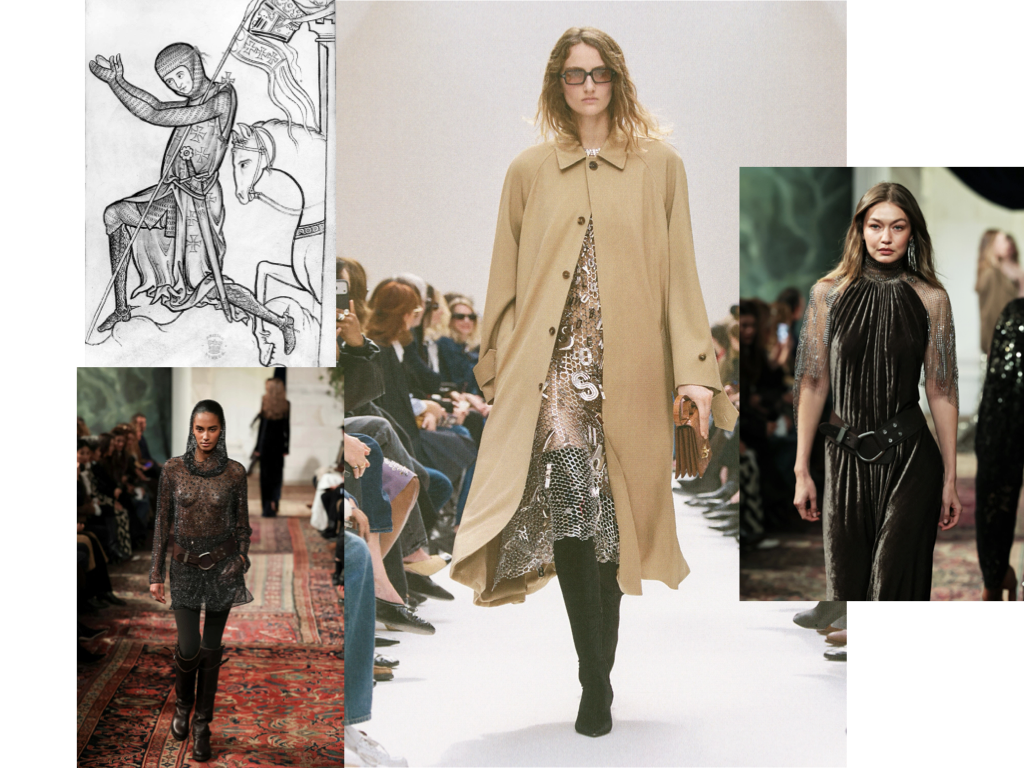
Clockwise from upper left to right: Henry III, British Museum; Celine Fall 2026; Ralph Lauren Fall 2026; and Ralph Lauren Fall 2026.
Sartorial Armor: The Knight
During the Middle Ages, battlefield armor was a necessity, as it shielded men from a whole host of weapons like swords, lances, and axes. Its biggest drawback, however, was its weight. Enter chainmail. Invented around the 4th or 5th century BCE, chainmail was made by linking small individual iron or steel rings together in a pattern to form a mesh. It solved the problem of maximizing body protection without sacrificing mobility. In fact, chainmail was so effective that it only fell out of favor in the 15th and 16th centuries as gunpowder revolutionized the technology of warfare.
On the Fall 2026 runways, chainmail emerged as the most prevalent Medieval motif, mirroring that historical balance between protection and movement. This idea was beautifully expressed at Celine, where an open-weave mesh dress punctuated with letter charms was layered under a classic trench coat—a styling choice that balanced security with novelty. Meanwhile, at Ralph Lauren, creative director Premda Wunderle offered a more romantic interpretation, pairing a feminine chainmail capelet over a velvet gown, as well as a draped, hooded tunic that lent a chic yet armor-like vibe to evening wear.
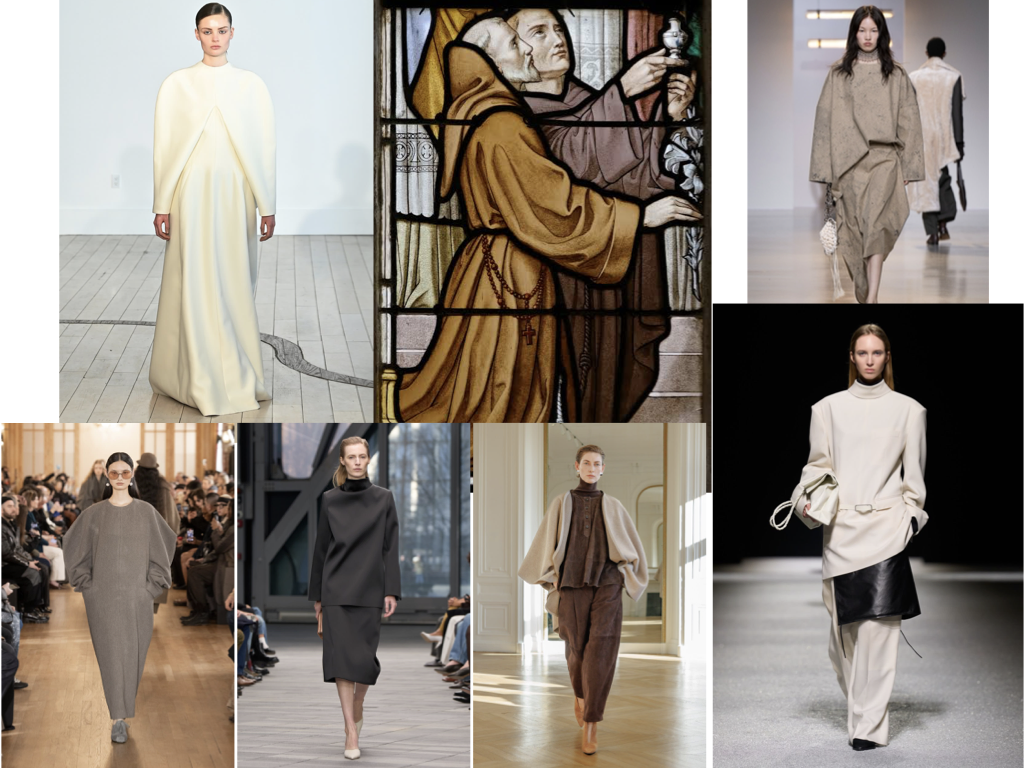
Clockwise from upper left to right: Ashlyn Fall 2026; a stained glass window from Saint Corentin Cathedral, Quimper, France, showing two kneeling Franciscan monks; Niccolò Pasqualetti Fall 2026; Issey Miyake Fall 2026; CO Fall 2026; Calvin Klein Fall 2026; and Uma Wang Fall 2026.
Monastic Simplicity: The Ascetic
Monks’ habits evolved from the humble, everyday tunic worn by peasants in the late Roman period. Originally, a long, simple undergarment made from coarse, woven wool, the garment was defined entirely by its utility. The cowl or hood served two purposes: providing modesty during prayer and offering protection from harsh elements. The un-dyed wool, which would have been black, brown or gray, represented humility and a rejection of worldly vanity. In short, the minimal, draped habits of medieval monastic orders valued utility, durability, and a rejection of excess.
This visual purity has emerged as the antidote to "Quiet Luxury" fatigue. While quiet luxury eventually became a social performance of understated wealth, this shift is about a deeper desire for grounding and functional elegance. Designers channeled this idea through architectural draping, as seen at Ashlyn, Uma Wang, Bottega Veneta, and Niccolò Pasqualetti, where oversized maxi dresses featured enveloping full sleeves and funnel necks. At Calvin Klein, this purity was abbreviated into a chic, minimalist skirt suit, while CO draped a fluid cape over a monochromatic suede top and trousers. Creative directors even incorporated the apron—traditionally an element of a monk’s working habit—as seen at Carven and Issey Miyake, where a leather version peeked out from beneath an oversized tunic top.
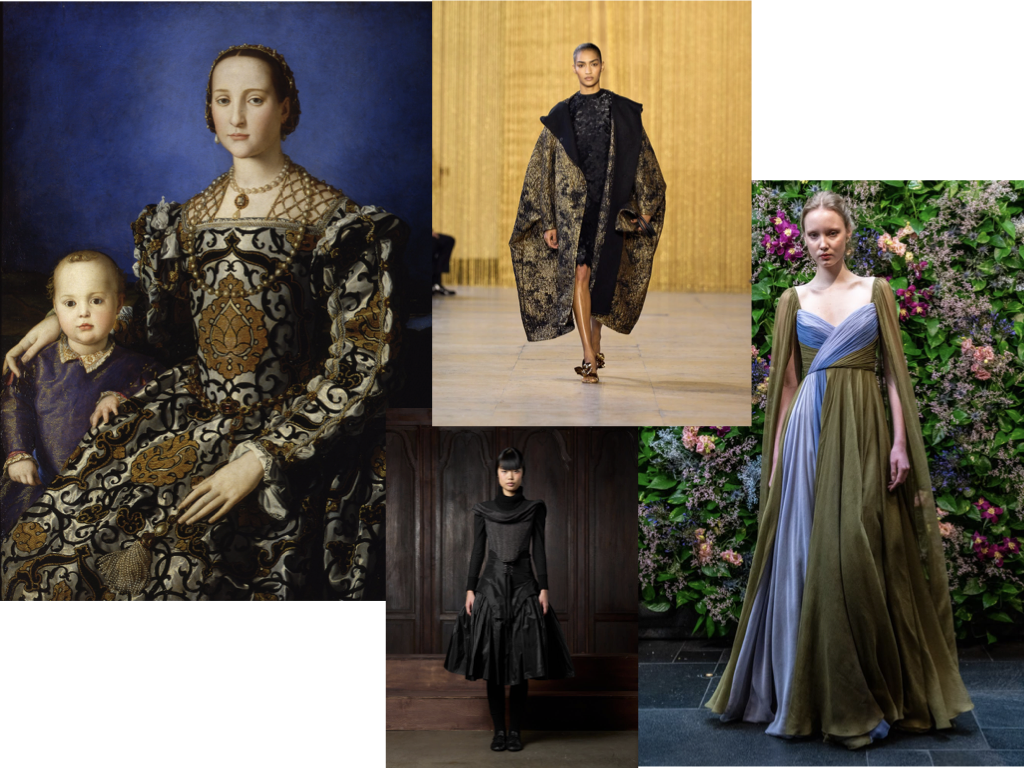
Clockwise from left to right: Eleonora of Toledo with her son Giovanni by Bronzino, 1545; Akris Fall 2026; Luisa Beccaria Fall 2026; and Meruert Tolegen Fall 2026.
The Guilds and Craftsmanship: The Artisan
Medieval trade guilds were powerful town-based associations of artisans and merchants that operated from the 11th to the 16th centuries. These localized centers tightly controlled the production, quality, and pricing of garments. They also protected the secrets of specialty workers like tailors, hand-weavers, dyers, and embroiderers, while restricting outside competition. In fact, this centuries-old protection of slow craft is the reason why Europe—and Paris in particular—retains its legendary network of specialized ateliers for expertise like pleating, embroidery, feather-work, and button-making.
On the Fall 2026 runways, creative directors proudly put their workshops’ technical skills on display, honoring this artisanal heritage. There were exquisite displays of craftsmanship at Luisa Beccaria, with a beautifully draped and pleated gown, and in Julie Kegels’s gorgeous pink double-faced wool gown featuring meticulously finished inside-out seams. At Akris, a voluminous evening coat in fragmented jacquard lamé showcased both luminous shine and texture. Meanwhile, Meruert Tolegen captured the romantic, structural spirit of the era with a full skirt anchored by a traditional stomacher and topped with a fluidly draped knit.
Detail of Roman chainmail replica from the 2nd century AD, photo courtesy of Matthias Kabel.